

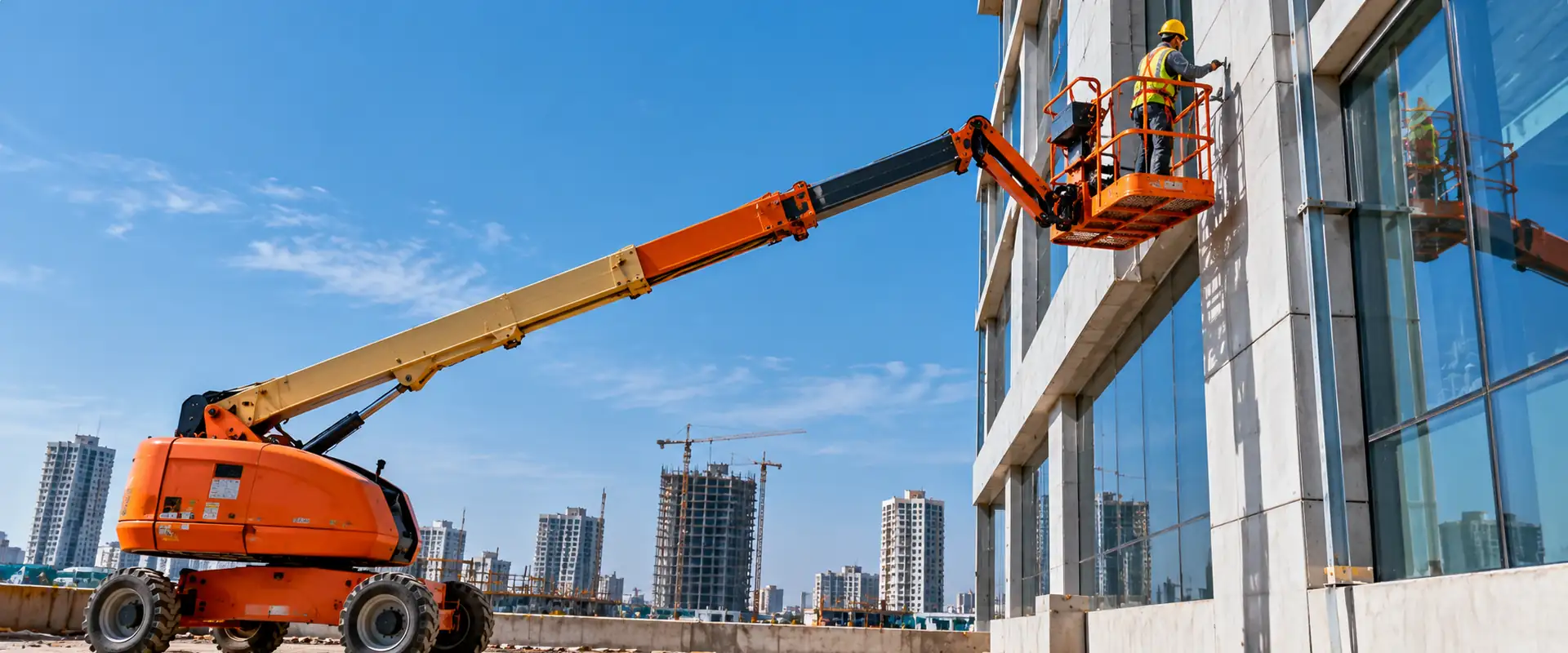
Choose a scissor lift when the work is straight above a floor you can drive on, and a boom lift when you have to reach up and out: over a pipe rack, past a canopy or across a slope. Then size the machine by working height, not platform height, and check the floor before you check the price.
- Scissor lifts go straight up and carry more people and material; boom lifts reach sideways and over obstacles.
- Working height is roughly platform height plus 2 m, the reach of a person standing on the platform.
- Battery machines suit indoor work and finished floors; diesel machines suit rough, open sites.
Scissor lifts: straight up, large platform
A scissor lift raises a wide platform vertically. It suits ceiling work, services installation, painting and cladding where the machine can be parked right under the job. Two families matter on Indian sites:
- Slab (electric) scissors for firm, level floors indoors. They are narrow enough for doorways, quiet, and produce no exhaust.
- Rough-terrain scissors, usually diesel, for open sites. They have larger tyres, more ground clearance and often outriggers, and many carry heavier loads on a bigger deck.
Boom lifts: reach up and out
A boom lift carries a small basket on an arm, so it can reach a point that is not directly above the machine.
- Telescopic booms extend in a straight line and give the most horizontal outreach for their height. Use them for building facades, steel erection and long reaches from the edge of a site.
- Articulated booms have a knuckle, so the basket can go up, over and down onto the work, for example over a pipe rack or into a roof structure.
Size it by working height
Manufacturers quote both platform height and working height. Working height is about 2 m more, because it allows for a person reaching up from the platform. Some examples from Genie's published specifications:
| Model | Type | Max working height | Platform capacity |
|---|---|---|---|
| Genie GS-2646 | Slab scissor | 9.96 m | 454 kg |
| Genie GS-4046 | Slab scissor | 13.89 m | 350 kg |
| Genie Z-45 XC | Articulated boom | 15.86 m | 300 kg |
| Genie S-65 XC | Telescopic boom | 21.81 m | 300 kg |
Source: Genie product pages on genielift.com, October 2026.
Measure the highest point you need to work at, add the clearance you want overhead, and ask for a machine whose working height covers it. For boom lifts, also measure the horizontal distance from where the machine can stand to the work: outreach, not height, is often what decides the model.
Check the ground before you choose
- Slab scissors need a firm, level, clean floor. Ask your structural team whether a suspended slab can take the machine's weight; the supplier can give you the machine weight and wheel loads.
- Rough-terrain machines still need compacted ground. Soft fill, trenches and slopes beyond the machine's rating are the common causes of incidents.
- Check doorway widths, ramps and lift (elevator) sizes on the route to the work area.
Battery or diesel
Battery machines suit indoor work, food and pharma plants and occupied buildings. Plan for charging: a power point near where the machine parks overnight is normally the site's scope. Diesel machines suit outdoor sites with longer shifts and no charging point; diesel is usually supplied by the site.
What to tell suppliers
- The highest working point and the horizontal reach needed.
- Indoor or outdoor, and the floor or ground condition.
- Access limits: doorway width, ramps, floor loading.
- Load on the platform: people, tools and materials.
- Whether you need an operator, and the hours per day.
When you know roughly what you need, request quotes on Clexen. Say what the platform has to do, and suppliers near your site will propose the right size; you can also browse what is listed.
Frequently asked questions
What is the difference between platform height and working height?
Platform height is the height of the platform floor. Working height adds about 2 m for a person standing on it and reaching up. Most hire requirements are stated as working height.
Can a scissor lift be used outdoors?
Rough-terrain scissor lifts are built for outdoor sites. Slab scissor lifts are meant for firm, level floors and are usually rated for little or no wind, so check the rating for the model offered.
When do I need an articulated boom instead of a telescopic boom?
When the basket has to go over something and then down or across, such as a pipe rack or roof truss. A telescopic boom gives more straight-line reach but cannot bend around obstacles.
Do I need a harness in a boom lift?
Fall-arrest harnesses attached to the basket anchor point are standard practice in boom lifts. Follow the manufacturer manual and your site safety rules.