
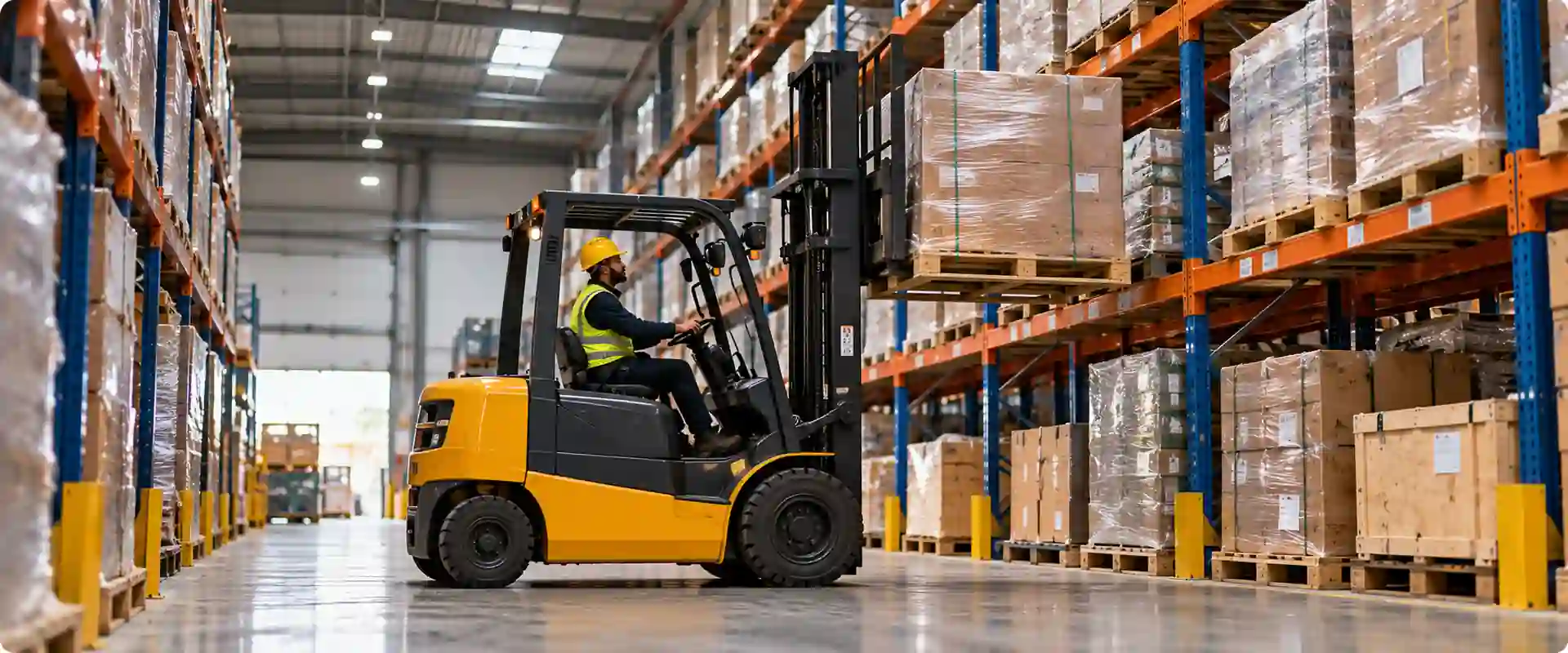
A forklift rated at 3 tonnes lifts 3 tonnes only when the load's centre of gravity sits at the rated load centre, commonly 500 mm from the fork face, and the mast is within its rated height. Longer or uneven loads, higher lifts and attachments all reduce what it can safely carry. Choose by the load, the lift height and the floor, then confirm against the machine's capacity plate.
- Rated capacity is quoted at a load centre, commonly 500 mm; a longer load means less capacity.
- Lift height and attachments such as side shifters also reduce capacity.
- Battery forklifts suit indoor and clean areas; diesel and LPG suit outdoor yards.
What load centre means
The load centre is the distance from the vertical face of the forks to the centre of gravity of the load. For a 1,000 mm deep pallet loaded evenly, the centre of gravity is 500 mm from the fork face, which is why 500 mm is a common rating point. If the load is longer, the centre moves out and the forklift can safely carry less. As a rough first check, capacity falls in proportion to the extra distance, but the real figure is on the machine's capacity plate, which accounts for the mast and attachments fitted.
Lift height and attachments
- Capacity at full mast height can be lower than at ground level, especially on taller masts. Check the plate for the height you need.
- Attachments add weight and move the load forward. A side shifter, fork positioner, clamp or rotator reduces the net capacity.
- Free lift matters in containers and low racking: it is how high the forks rise before the mast extends upward.
Which power type
| Type | Best for | Plan for |
|---|---|---|
| Battery (electric) | Warehouses, food and pharma, indoor work | A charging point and charging time; the site usually provides power |
| Diesel or LPG | Outdoor yards, longer shifts, rough surfaces | Fuel or gas supply and exhaust ventilation if used indoors |
Tyres and floors
Solid or cushion tyres suit smooth concrete floors. Pneumatic tyres suit uneven outdoor surfaces. Check ramps, dock levellers and floor loading for heavier machines.
Forklift or telehandler
When you need to place loads high and forward, such as onto a slab edge or over an obstacle on an open site, a telehandler may be better. Like a forklift, its capacity falls as the boom extends, so read its load chart for the reach you need.
What to tell suppliers
- Heaviest load, its dimensions and how it is packed.
- Highest lift height, and any container or racking clearances.
- Indoor or outdoor, and the floor surface.
- Attachments needed, such as a side shifter.
- Shift pattern: hours per day and days per week.
When you know roughly what you need, request quotes on Clexen. Say what the forklift has to do, and suppliers near your site will propose the right size; you can also browse what is listed.
Frequently asked questions
What is the load centre of a forklift?
The distance from the fork face to the load's centre of gravity at which the rated capacity applies. 500 mm is a common rating point.
Can a 3-tonne forklift lift a 3-tonne long load?
Not always. If the load centre is further than the rated load centre, safe capacity is lower. Check the capacity plate for the actual load centre and lift height.
Do attachments reduce forklift capacity?
Yes. Attachments add weight and move the load forward, so the net capacity falls. The capacity plate should show the rating with the attachment fitted.
Electric or diesel forklift?
Electric for indoor and clean areas with charging available; diesel or LPG for outdoor yards and long shifts.